- Home
- Current Sensors
- Programmable Current Sensors
- ISB-A-802 SERIES: Busbar-Mount Programmable Current Sensors
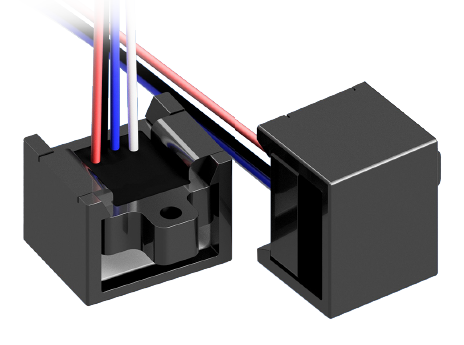
Key Features
- Programmable sensing range from ±100 A to ±670 A
- Wideband DC–200 kHz operation for fast-switching power systems
- 4300 VAC isolation supporting high-voltage industrial design
- Fast analog response around 3 µs enabling real-time control
- Lead-wire package offering flexible mounting and remote placement
- Compact busbar-mount format simplifying power-module integration
- Ratiometric analog output compatible with ADCs and control ICs
Applications
- DC/DC and AC/DC converter current monitoring
- Battery systems and energy-storage current measurement
- Motor drives, VFDs, and industrial motion control
- Solar inverters and renewable-energy converters
- Welding equipment and high-current power systems
- Real-time current feedback for protection circuits
- DC/DC and AC/DC converter current monitoring
- Battery systems and energy-storage current measurement
- Motor drives, VFDs, and industrial motion control
- Solar inverters and renewable-energy converters
- Welding equipment and high-current power systems
- Real-time current feedback for protection circuits
Part Number
Measurable Current Range
Output Slope
Accuracy
Linearity Error
Response Time
Top View
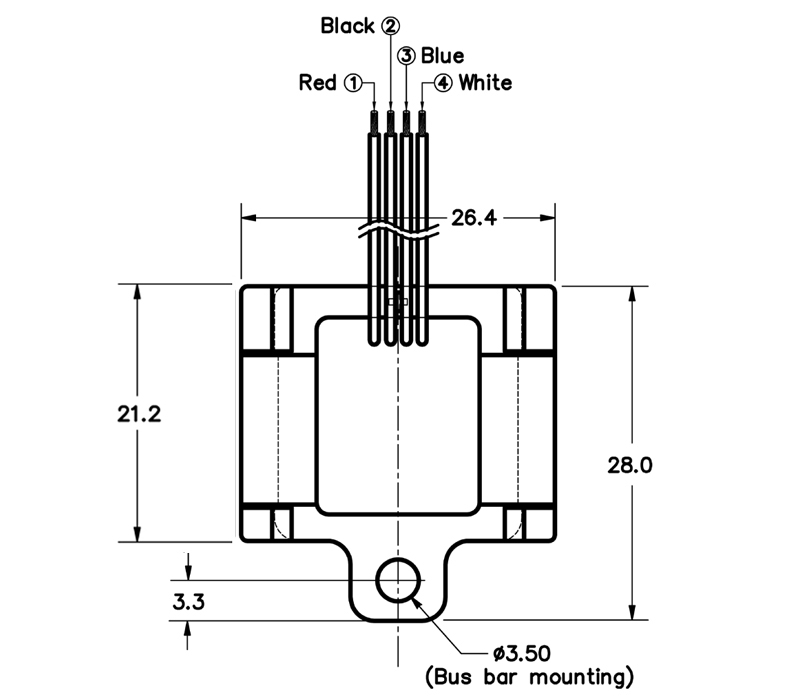
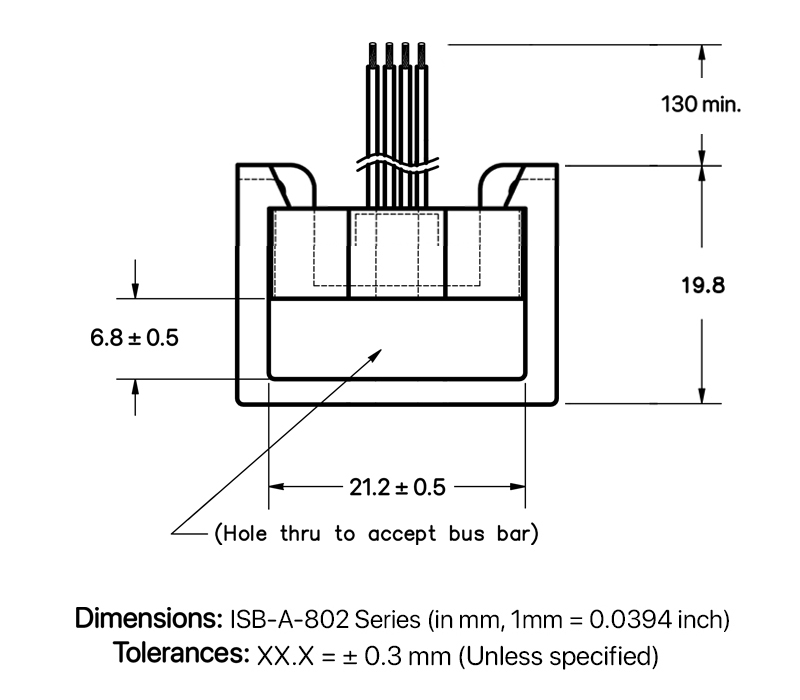
Front View
Busbar Mounting
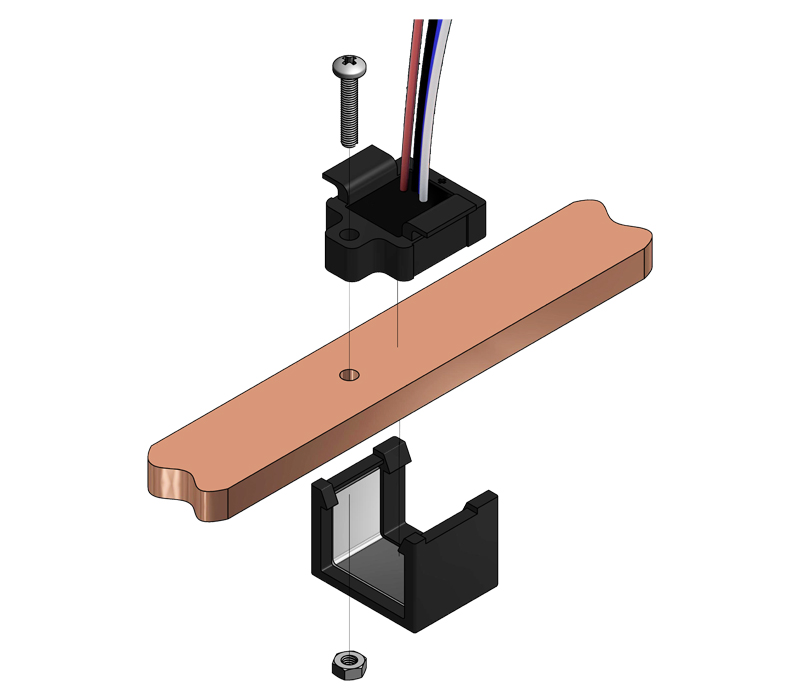
-
GENERAL DATA
●Ambient Operating Temperature: -40 to +105 °C
●Ambient Storage Temperature: -40 to +105°C
●RMS Voltage for AC Insulation: 4.3 kV
●Creepage Distance: > 130 mm
●Clearance Distance: > 130 mm
●Safety Standard: EN50178
●EMC Standard: EN61000
-
ABSOLUTE MAXIMUMS
●Over-Voltage VDD Protection: +10 V
●Reverse VDD Protection: -10 V
●Output Voltage Max: +10 V
●Output Current Max: +/- 70 mA
●Reverse Output Voltage Max: -0.3 V
●Reverse Output Current Max: -50 mA
NOTES
- All specifications at 25°C.
- Specifications dependent on mechanical attachment.
- Specifications are % full scale.
- Output slope is dependent on Vdd. Specifications above assumes 5Vdd. Vref = 50%Vdd +/- 1%
- We recommend mounting the sensors with non-magnetic screws for maximum accuracy. We recommend stainless steel, brass, bronze, copper or aluminum.
- Specifications subject to change without prior notice.
Frequently Asked Questions (FAQs)
What should designers consider when selecting a model?
Match current range, output slope, bandwidth requirements, isolation needs, and wiring layout for the intended system.
How does the ISB-A 802 differ from the ISB-A 800?
The ISB-A-800 uses a 1.00 mm pitch shrouded header connector (JST BM04B-SRSS-TB with the appropriate mating connector), providing a creepage distance of 8.5 mm. In contrast, the ISB-A-802 is supplied with stranded #22 AWG UL3239-rated lead wires, rated for 3 kV. The standard 150 mm lead length significantly increases the creepage distance to 158.5 mm, with custom lead lengths available upon request.
What current ranges does the ISB-A 802 support?
Variants measure currents from ±100 A to ±670 A, making the series suitable for a wide range of industrial and power-conversion applications.
Can the sensor measure both AC and DC signals?
Yes — the DC–200 kHz bandwidth supports DC, low-frequency AC, switching waveforms, and high-speed transient detection.
Why is the 4300 VAC isolation important?
It ensures safe separation between high-voltage power paths and low-voltage control electronics, critical for converters, inverters, and battery packs.
What type of output does the sensor provide?
A ratiometric analog voltage proportional to sensed current. The slope depends on the variant (e.g., 20 mV/A or 6.67 mV/A).
Where is the ISB-A 802 especially useful?
In systems requiring remote placement of the sensor — such as inside power cabinets, harnesses, or areas with mechanical constraints.
Is the response time suitable for protection circuits?
Yes — the ~3 µs response allows fast overcurrent detection and stable control-loop feedback.
What are the power supply requirements?
The device operates from a regulated 5 V ±0.5 V supply for consistent analog output.
How should the sensor be mounted for best accuracy?
Secure placement with non-magnetic hardware is recommended to prevent magnetic distortion. We recommend mounting the sensors with non-magnetic screws for maximum accuracy - materials such as stainless steel, brass, bronze, copper or aluminum.