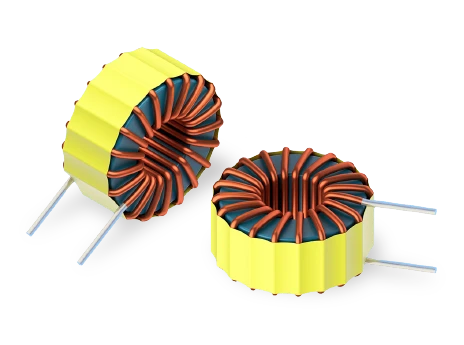
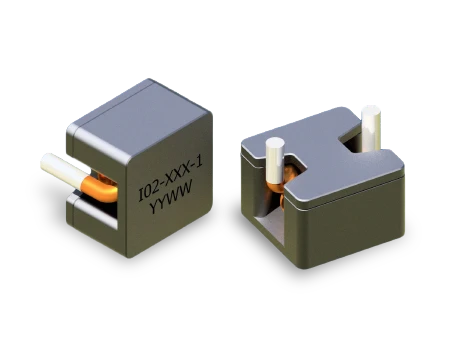
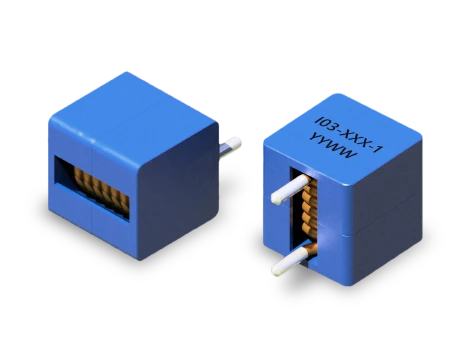
Selecting a high-current powdered-iron power inductor requires careful evaluation of inductance, DC resistance, saturation behavior, thermal performance, and operating frequency. The distributed air gap inherent in powdered-iron cores supports gradual inductance reduction under increasing DC bias, making these inductors well suited for applications that experience high current levels or transient loads.
For a detailed explanation of energy storage, current ripple, core saturation, winding losses, and component selection, explore our Power Inductor Fundamentals guide.
For additional application guidance and detailed performance information, download our application note: ITP High Current Toroidal Inductors.
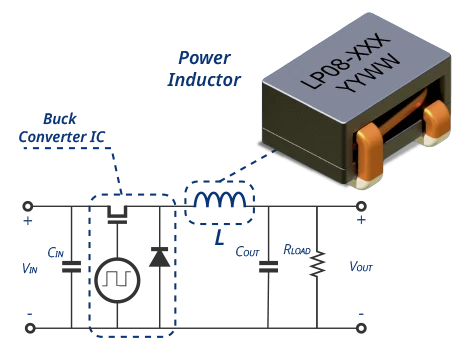
ICE develops custom high current inductors for demanding power conversion stages that require robust mechanical stability and strong DC bias performance. Core selection, wire gauge, winding configuration, and saturation current can be optimized to meet specific efficiency, thermal, and space constraints.
From powdered iron to toroidal geometries, we engineer inductors to deliver controlled EMI, predictable inductance under load, and low DCR performance. Custom inductance values and current ratings are available to support VRMs, industrial power supplies, and high-current filtering applications.
Open Request Form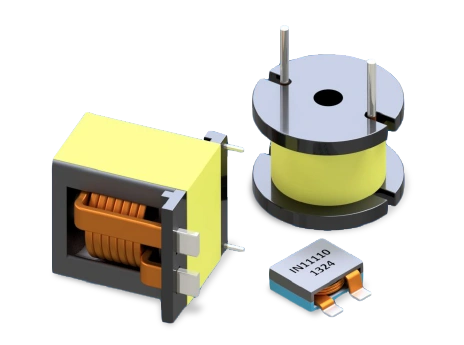
Saturation current is the DC current level where inductance begins to decrease due to core saturation. Powdered iron materials provide soft saturation characteristics, allowing inductance to decrease more gradually under high load conditions. This helps improve stability in high-current switching regulators and power conversion stages.
Lower DCR reduces conduction losses and heat generation in the inductor winding. This improves overall converter efficiency, especially in high-current applications where I²R losses become significant. Low-DCR inductors also support better thermal performance in compact power designs.
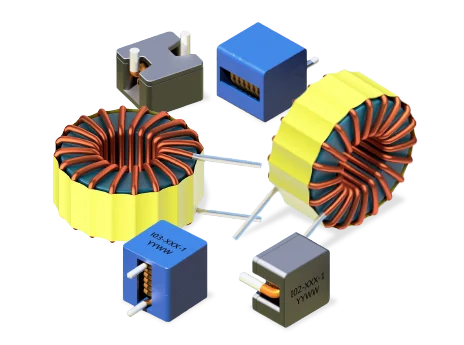
Toroidal inductors help contain magnetic flux within the core structure, reducing EMI radiation and coupling into nearby circuits. They also provide efficient magnetic path utilization and strong mechanical stability for high-current applications.
Increasing DC current reduces effective permeability, causing inductance to drop under load. Powdered iron cores maintain more predictable inductance under DC bias because of their distributed air-gap structure, making them suitable for energy storage applications.
Audible noise is typically caused by core vibration, winding movement, or magnetostriction under switching conditions. High ripple current and poor mechanical stabilization can increase acoustic noise in power converter designs.
Inductance selection depends on switching frequency, operating voltage, and allowable ripple current. Higher inductance reduces ripple current, while lower inductance improves transient response. The optimal value depends on efficiency, thermal, and space constraints.
Yes. Powdered iron inductors are commonly used in industrial and high-power systems operating at elevated ambient temperatures. Actual performance depends on thermal rise, airflow, core material, and PCB layout conditions.
Saturation current defines when inductance drops due to magnetic saturation, while rated current is based on allowable temperature rise. Both parameters should be evaluated when selecting inductors for high-current operation.
Core material affects core loss, saturation behavior, and DC bias stability. Powdered iron cores are widely used because they provide soft saturation characteristics and stable performance in high-current switching applications.
Yes. High-current powdered iron inductors are designed for continuous operation in VRMs, industrial power supplies, and DC-DC converters. Proper thermal management and current derating help ensure long-term reliability.
 Search Powdered-Iron Power Inductors