- Home
- Current Sensors
- Programmable Current Sensors
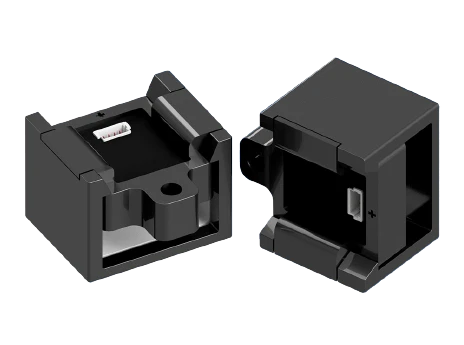
- ISB-A-800 SERIES: Busbar-Mount Programmable Current Sensors
Key Features
- Programmable sensing range from ±100 A to ±670 A
- Wideband DC–200 kHz operation supporting fast-switching systems
- High-isolation design rated to 4300 VAC for safety-critical applications
- Fast analog response around 3 µs for real-time monitoring
- Compact busbar-mount package simplifying mechanical integration
- Analog output slope compatible with standard control and ADC interfaces
Applications
- DC/DC and AC/DC converter current monitoring
- Battery management and energy storage systems
- Motor drives, VFDs, and industrial motion control
- Solar inverters and renewable-power converters
- Welding systems and high-current industrial equipment
- Real-time current feedback for protection circuits
Electrical Specifications @ 25°C - Operating Temperature Range: -40°C to +85°C
Part Number
Measurable Current Range
Output Slope
Accuracy
Linearity Error
Response Time
Top View
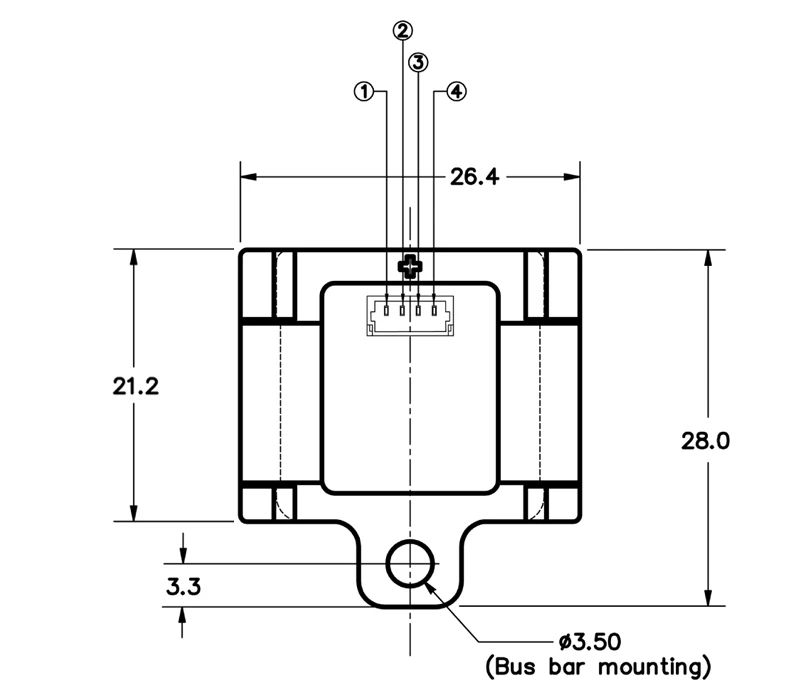
Front View
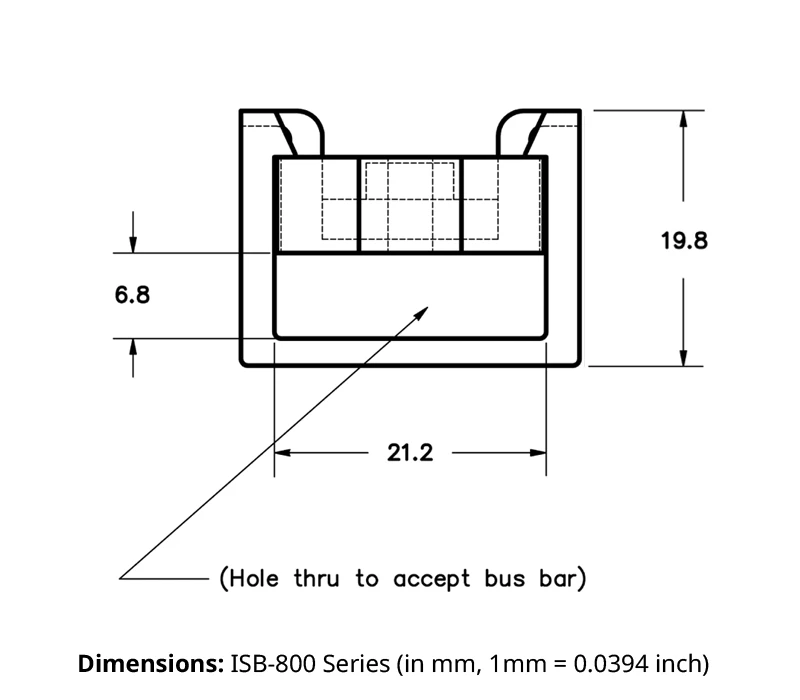
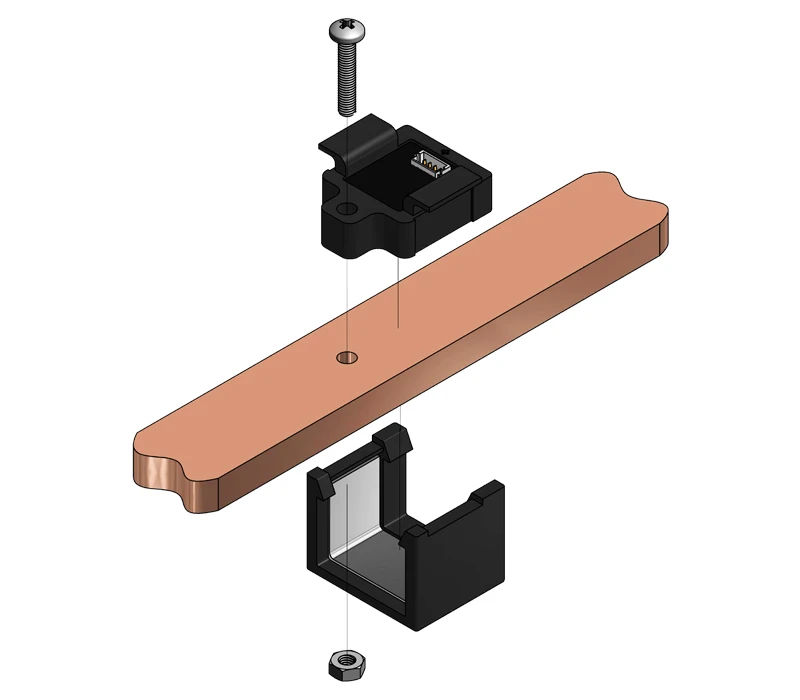
Busbar Mounting
-
GENERAL DATA
●Ambient Operating Temperature: -40 to +85°C
●Ambient Storage Temperature: -40 to +90°C
●RMS Voltage for AC Insulation: 4.3 kV<
●Creepage Distance: 8.5 mm
●Clearance Distance: 8.5 mm
●Safety Standard: EN50178
●EMC Standard: EN61000
-
ABSOLUTE MAXIMUMS
●Over-Voltage VDD Protection: +10 V
●Reverse VDD Protection: -10 V
●Output Voltage Max: +10 V
●Output Current Max: +/- 70 mA
●Reverse Output Voltage Max: -0.3 V
●Reverse Output Current Max: -50 mA
NOTES
- All specifications at 25°C.
- Specifications dependent on mechanical attachment.
- Specifications are % full scale.
- Output slope is dependent on Vdd. Specifications above assumes 5Vdd. Vref = 50%Vdd +/- 1%
- We recommend mounting the sensors with non-magnetic screws for maximum accuracy. We recommend stainless steel, brass, bronze, copper or aluminum.
- Specifications subject to change without prior notice.
Frequently Asked Questions (FAQs)
What current ranges are available in the ISB-A 800 Series?
Models support ±100 A to ±670 A, allowing designers to choose the ideal range for light, medium, or heavy-load power systems.
What type of output does the sensor provide?
A proportional analog voltage output (e.g., 20 mV/A or 6.67 mV/A depending on the model) that interfaces easily with ADCs and control processors.
Can the ISB-A 800 measure both AC and DC currents?
Yes — the DC–200 kHz bandwidth allows sensing of DC, AC, and switching waveforms used in converters and motor drives.
How does the 4300 VAC isolation rating impact system design?
It provides a safe electrical barrier between high-voltage supplies and control electronics, ensuring compliance with industrial insulation requirements.
Is the response time suitable for fast protection circuits?
With ~3 µs response time, the ISB-A 800 supports real-time overcurrent protection and dynamic control loops.
Can this sensor be used directly on a busbar?
Yes — the mechanical design is optimized for busbar mounting, providing stable alignment and reducing wiring inductance.
What installation guidelines should be followed?
Use non-magnetic screws to prevent flux distortion and ensure maximum measurement accuracy.
Does the analog output depend on supply voltage?
Yes, the output is ratiometric with VDD, so proper supply regulation ensures consistent measurement accuracy.
What applications benefit most from the wide bandwidth?
Solar inverters, motor drives, welding systems, and fast-switching DC/DC converters all rely on wideband current feedback.
How should a designer choose the right current range?
Select a model that provides enough headroom for peak currents while maximizing output resolution for the expected operating range.