


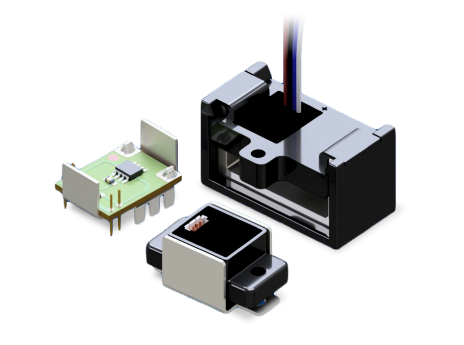
Current-sensing requirements vary with current waveform, measurement range, bandwidth, isolation, accuracy, temperature, and installation constraints. ICE Components engineers custom current-sensing solutions for power conversion, motor control, industrial equipment, and energy systems.
Our engineers evaluate AC and DC current ranges, peak current, frequency, duty cycle, isolation, and thermal conditions. These inputs guide the sensing technology, magnetic circuit, conductor geometry, output configuration, and package design. Submit your electrical and mechanical requirements below to begin the engineering assessment.
(Write none or n/a if the field is not applicable)
Current range alone does not define a current sensor’s suitability. Bandwidth, response time, accuracy, isolation, output format, and temperature stability also affect system performance.
Conductor geometry influences resistance, power dissipation, magnetic-field distribution, and measurement sensitivity. Offset, gain error, linearity, hysteresis, and thermal drift determine accuracy across the operating range.
The surrounding circuit also affects sensor integration. PCB routing, busbar placement, nearby magnetic fields, and isolation spacing can influence the final measurement. A system-level design approach helps maintain reliable current feedback in power converters, motor drives, energy storage, and industrial equipment. If your application presents unique electrical, mechanical, or environmental challenges, our engineering team can help evaluate the requirements and develop a current-sensing solution optimized for your system.