- Home
- Current Sensors
- Programmable Current Sensors
- ISE-A-800 Series
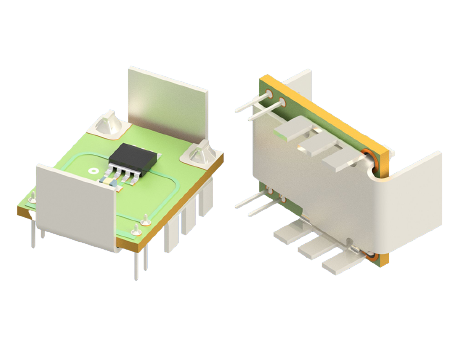
Key Features
- Factory programmable current ranges
- Four standard ranges from ±50 A to ±200 A for power-system flexibility
- DC–200 kHz bandwidth supporting AC, DC, and switching currents
- Analog ratiometric output simplifying interface to ADCs and controllers
- Fast 3 µs response time enabling real-time control and protection
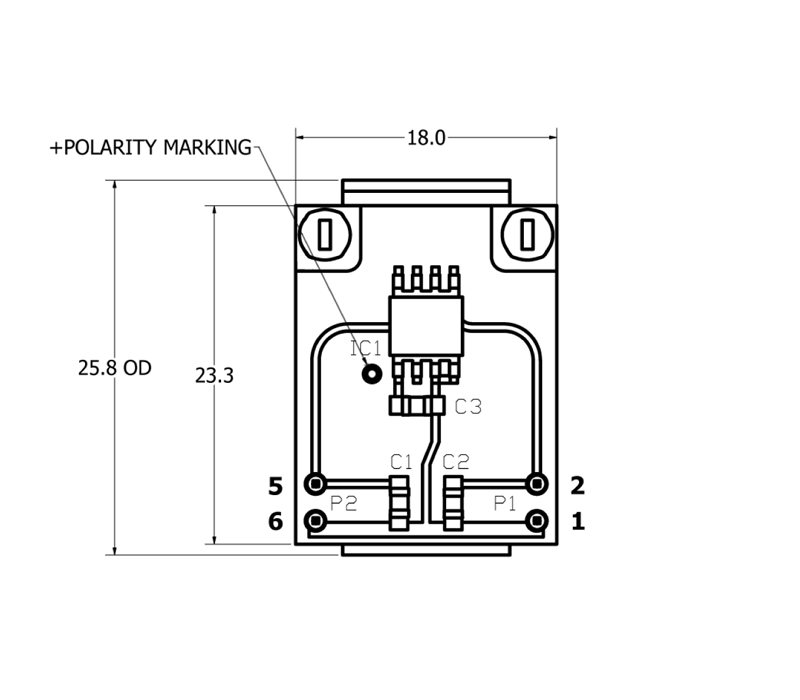
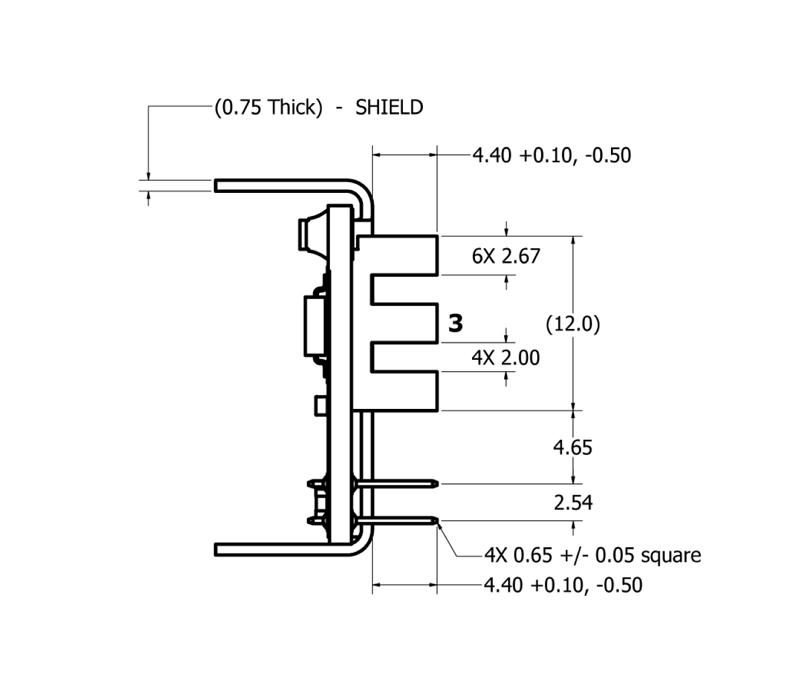
- Compact 18 × 26 mm PCB footprint with low 10.8 mm profile
- Single 5 V supply with low operating current for easy integration
Applications
- DC/AC converter and inverter current monitoring
- DC/DC converter and regulated power stage sensing
- Battery management and energy-storage system monitoring
- Motor drives, VFDs, and industrial motion control
- Welding equipment and high-current power modules
- Solar and renewable-energy power electronics
- DC/AC converter and inverter current monitoring
- DC/DC converter and regulated power stage sensing
- Battery management and energy-storage system monitoring
- Motor drives, VFDs, and industrial motion control
- Welding equipment and high-current power modules
- Solar and renewable-energy power electronics
Part Number
Measurable Current Range
Output Slope
Accuracy
Linearity Error
Response Time
Top View
Side View
Front View
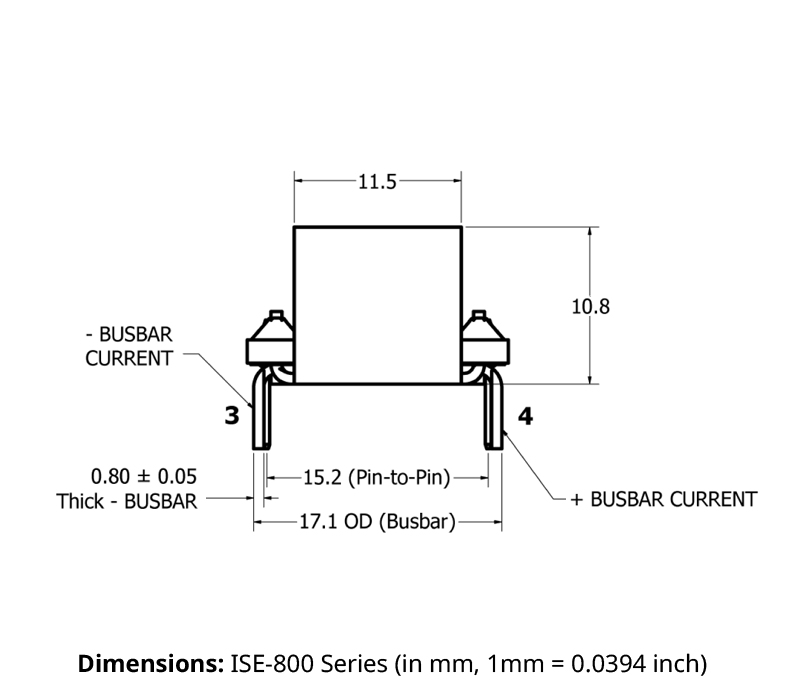
-
GENERAL DATA
•Ambient Operating Temperature: -40 to +130 °C
•Ambient Storage Temperature: -40 to +130 °C
•Creepage Distance: 1.4 mm
•Clearance Distance: 1.4 mm
-
ABSOLUTE MAXIMUMS
•Over-Voltage Vdd Protection: +10 V
•Output Voltage Max: +10 V
•Output Current Max: +/- 70 mA
•Reverse Output Voltage Max: -0.3 V
•Reverse Output Current Max: -50 mA
NOTES:
•All specifications at 25°C.
•Specifications dependent on mechanical attachment.
•Specifications are % full scale.
•Output slope is dependent on Vdd.
•Specifications above assumes 5 Vdd.
•Specifications subject to change without prior notice.
Frequently Asked Questions (FAQs)
How does the ISE-A 800 measure current?
It uses an open-loop Hall-effect sensor to detect magnetic fields around the conductor, enabling isolated measurement without inserting resistance or causing power loss.
Why is the output ratiometric?
The output scales with the 5 V supply, ensuring sensor and ADC track together, which reduces measurement error in systems using the same reference.
How do the different current ranges affect resolution?
Lower ranges (±50 A) provide higher sensitivity, while higher ranges (±200 A) allow measurement of larger currents with lower slope.
What is the benefit of the 200 kHz bandwidth?
It allows accurate sensing of DC, AC, switching ripple, and fast transients used in converters and motor drives.
How fast is the sensor?
≈3 µs response supports real-time feedback and quick detection of overcurrent or switching events.
How should the sensor be mounted for best accuracy?
Keep the primary conductor centered and use non-magnetic hardware to avoid field distortion.
Does it provide isolation?
Yes — the Hall-effect structure provides galvanic separation, and creepage/clearance spacing supports board-level industrial applications.
How stable is it over temperature?
It maintains accuracy across –40 °C to +130 °C, with predictable drift that can be corrected through system calibration.
What system noise considerations apply?
Use short traces and good grounding for the analog output; optional RC filtering improves ADC stability.
When is this sensor preferred over a shunt resistor?
When low power loss, isolation, compact PCB footprint, or wide bandwidth is needed for converters, motor drives, or battery systems.