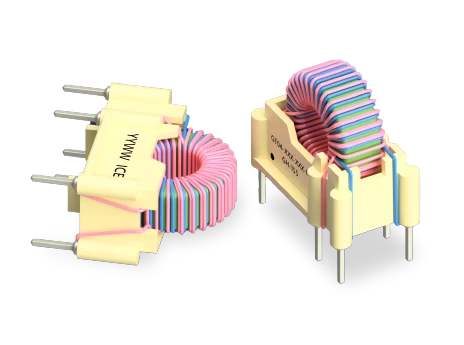
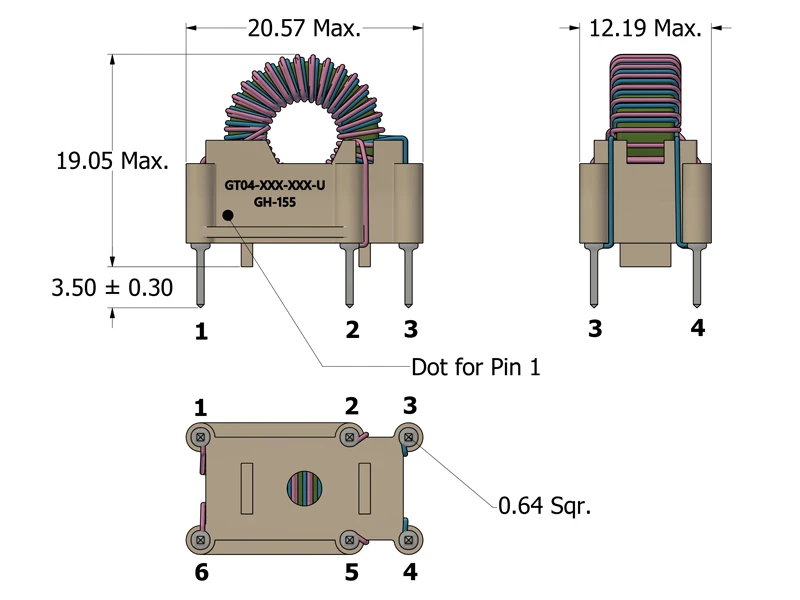
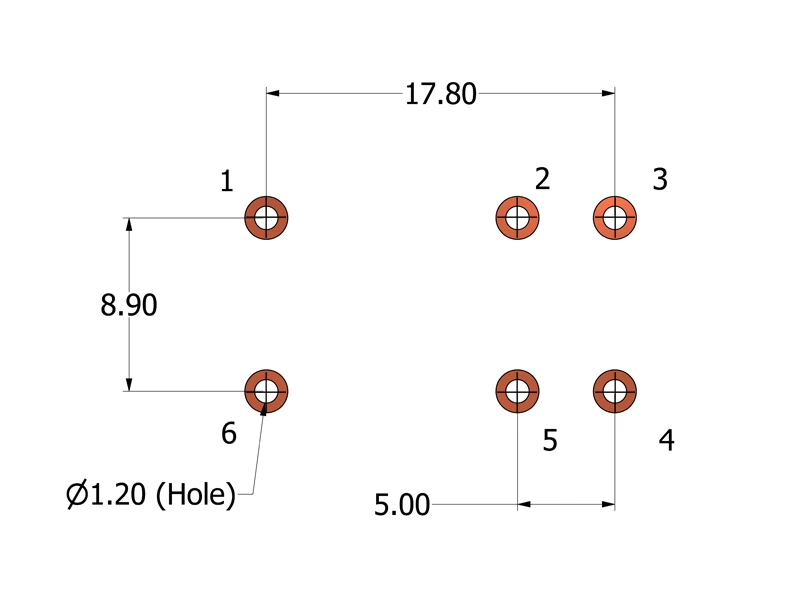
The GT04 Series is a robust through-hole gate drive transformer engineered for high-voltage isolation and demanding offline power applications. Featuring a 19.05 mm maximum profile for vertical integration and a standard 20.57 mm × 12.19 mm footprint, this series delivers reliable isolation performance in AC/DC and DC/DC converters operating across industrial environments. Select models are designed to meet updated insulation requirements in accordance with IEC 61558-1 and IEC 62368-1, supporting reinforced insulation in modern safety-critical designs.
Designed for operating frequencies from 20 kHz to >300 kHz, the GT04 Series provides up to 4,500 V (4.5 kV) isolation capability with controlled leakage inductance for accurate pulse transfer. Its rugged construction and enhanced insulation system make it well suited for signal isolation across high-voltage barriers, industrial motor drives, renewable energy inverters, and high-power switch-mode power supplies.
Specifications subject to change without prior notice.
Frequently Asked Questions (FAQs)
What effect does the GT04’s turns ratio have on gate voltage delivered to the power device?
+
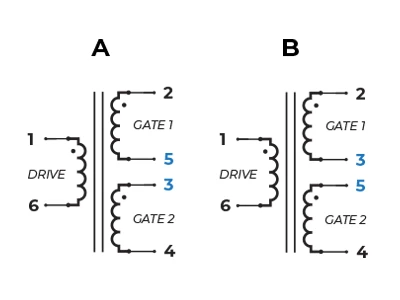
GT04 parts are offered with either 1:1:1 or 1:2.5:2.5 primary:secondary:tertiary turns ratios. A higher secondary ratio (1:2.5) increases the voltage seen at the gate relative to the driver’s primary voltage, allowing designers to tailor gate drive amplitude to the MOSFET/IGBT requirements without changing the driver IC.
How does drive inductance influence gate-drive waveform shape?
+
Drive inductance values in the GT04 range from approximately 0.039 mH to 8.91 mH depending on variant. Higher inductance tends to slow down current changes, flattening and broadening pulses, while lower inductance supports sharper transitions but can increase driver current demand. Selecting the appropriate inductance ensures proper balance between pulse fidelity and driver loading.
What role does leakage inductance play in the GT04’s performance?
+
Leakage inductance (listed up to ~1500 nH on larger variants) limits how tightly the magnetic flux is coupled between windings. Lower leakage helps maintain clean gate transitions and reduces overshoot or ringing. Higher leakage may be acceptable in slower switching systems but can cause waveform distortion in high-speed designs.
How should ET product (V-µs) be considered in driver design?
+
The GT04’s ET product — ranging from ~63 V-µs to ~378 V-µs across variants — represents the Volt-microsecond area the core can support before saturation. Designers should ensure the gate-drive pulse voltage and duration do not exceed this rating, especially at low switching frequencies, to prevent core saturation and waveform distortion.
Why is SRF (self-resonant frequency) relevant even if it’s not a primary spec?
+
SRF values (typically 0.3–4.3 MHz) indicate where winding parasitic inductance and capacitance resonate. Operating too close to SRF can lead to unintended peaking or attenuation of gate pulses. Staying well below SRF helps maintain predictable transformer behavior in the specified 20 kHz–300 kHz range.
How does the isolated 4500 VDC rating affect safety and layout?
+
The GT04 Series provides robust isolation between the drive and gate windings with a 4.5 kVDC dielectric rating, enabling safe operation in high-voltage AC/DC converters and offline supplies. Designers should maintain appropriate creepage and clearance distances on the PCB to preserve this isolation in finished assemblies.
What practical impact does winding DCR have on driver loading?
+
DCR values (e.g., 40 mΩ–2700 mΩ depending on winding and variant) directly affect how much current the transformer draws from the driver. Lower DCR reduces resistive loss and reduces driver stress but may increase magnetizing current. Selecting a variant with proper DCR helps avoid excessive power loss and driver heating.
How should I choose between the 1:1:1 and 1:2.5:2.5 variants?
+
Use the 1:1:1 variants for gate-drive circuits where the gate threshold and voltage swing are close to the driver’s native voltage. Choose 1:2.5:2.5 variants when higher gate-drive voltages are needed without changing driver supply voltages, such as when driving higher-gate-charge devices or optimizing switching performance.
Do GT04 transformers require specific driver impedance matching?
+
Driver impedance affects how quickly energy is transferred into the transformer’s magnetizing inductance. Drivers with low output impedance allow sharper edges and less distortion in the gating waveform. Ensuring the driver can source and sink sufficient current for the transformer’s inductance and DCR helps achieve clean switching performance.
What should be checked when validating GT04 performance in simulation?
+
Engineers should include the transformer’s actual drive inductance, leakage inductance, DCR, ET product, and turns ratio in simulation models rather than treating the transformer as ideal. This yields more realistic predictions of gate voltage amplitude, rise/fall times, and current draw on the driver during switching events.
Quote Request for GT04 SERIES: High-Isolation THT Gate Drive Transformers
Sample Request for GT04 SERIES: High-Isolation THT Gate Drive Transformers
SPICE Data Download for GT04 SERIES: High-Isolation THT Gate Drive Transformers
Here is the Spice data file for GT04 SERIES: High-Isolation THT Gate Drive Transformers Download
3D File Download for GT04 SERIES: High-Isolation THT Gate Drive Transformers
Here is the 3D file for GT04 SERIES: High-Isolation THT Gate Drive Transformers
Download
To provide the best experiences, we use technologies like cookies to store and/or access device information. Consenting to these technologies will allow us to process data such as browsing behavior or unique IDs on this site. Not consenting or withdrawing consent, may adversely affect certain features and functions.
Functional
Always active
The technical storage or access is strictly necessary for the legitimate purpose of enabling the use of a specific service explicitly requested by the subscriber or user, or for the sole purpose of carrying out the transmission of a communication over an electronic communications network.
Preferences
The technical storage or access is necessary for the legitimate purpose of storing preferences that are not requested by the subscriber or user.
Statistics
The technical storage or access that is used exclusively for statistical purposes.The technical storage or access that is used exclusively for anonymous statistical purposes. Without a subpoena, voluntary compliance on the part of your Internet Service Provider, or additional records from a third party, information stored or retrieved for this purpose alone cannot usually be used to identify you.
Marketing
The technical storage or access is required to create user profiles to send advertising, or to track the user on a website or across several websites for similar marketing purposes.