• 1.

    Operating Temp. Range: The combination of ambient temperature and temperature rise.

  • 2.

    Secondary Inductance: Tested at 10kHz, 0.1VRMS.

  • 3.

    Primary DCR (1-3): 4.6 mΩ (Ref)

  • 4.

    Current Rating: Peak current (50% duty cycle) through primary (1-3) to cause 40°C temperature rise at 25°C ambient.

  • 5.

    SRF: Values are for reference only.

  • 6.

    Flammability Standard: Meets UL 94V-0.

  • 7.

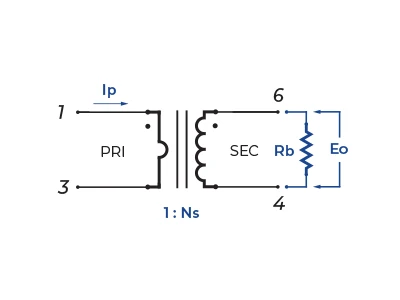
    Terminating Resistor (RB): To calculate the value use the formula,
    RB = EOTR/IP

  • 8.

    ET Product: The maximum ET is based upon a flux density of 3700 Gauss at 25°C. Suitable for bipolar applications only.

    ET = EO/2f
    EO = IPRB/TR

    Where as,

    EO = Output voltage (V)   TR = Turns Ratio
    RB = Term. Resistor (Ω)       f = Frequency (Hz)
    IP = Primary Current (A)

  • 9.

    PACKAGING

    • Reel Diameter: 13”

    • Reel Width: 24mm

    • Pieces/Reel: 500

  • 10.

    Compliance & Solutions:

    RoHS Compliant    Custom Solutions

  • 11.

    Specifications subject to change without prior notice.

Frequently Asked Questions (FAQs)

How does CT09 behave at very light load currents?

+
At low primary currents, the secondary output amplitude decreases proportionally, which may require a higher-gain sensing stage. Designers should ensure that the burden resistor and controller input can reliably detect the lowest expected current without excessive noise sensitivity.

What factors most influence CT09’s measurement accuracy?

+
Accuracy is affected by burden resistor selection, PCB layout parasitics, switching frequency relative to the part’s SRF, and waveform shape. Operating close to SRF or ET-product limits can introduce distortion, especially with high di/dt waveforms.

Does CT09 require filtering at the controller input?

+
Most SMPS current-sense implementations use minimal RC filtering to reduce switching spikes while preserving waveform integrity. CT09 can operate with or without filtering, but the RC time constant must not excessively slow the sensed waveform or alter peak detection.

How do I avoid saturating CT09 in my design?

+
Saturation occurs when the ET-product limit is exceeded due to excessive volt-seconds on the core. To prevent this, ensure the burden resistor value and switching frequency remain within the datasheet’s ET constraints and avoid overly long on-times at high currents.

Does the orientation of CT09 on the PCB matter?

+
Electrically, orientation does not affect performance; however, placement near noisy switching nodes may increase capacitive coupling. Keeping the transformer and sense traces isolated from high-dv/dt nodes improves waveform clarity.

How well does CT09 reject common-mode noise?

+
As an isolated transformer, CT09 naturally rejects DC and low-frequency common-mode components, but high-frequency common-mode EMI can couple through parasitic capacitances. Proper grounding and short sense-trace routing help minimize this effect.

Can CT09 be used for peak-current mode control without distortion?

+
Yes, when operated within its SRF and ET limits. For peak-current mode, ensuring minimal propagation delay in the sense path and avoiding excessive filtering helps maintain the required fast current-loop response.

What happens if the burden resistor is placed far from the transformer?

+
Long trace lengths increase inductance and capacitance, which can distort fast edges or cause ringing. For best signal integrity, place the burden resistor as close as possible to the CT09 secondary pins.

Can CT09 be used to sense bidirectional current?

+
Yes — as long as the waveform alternates or resets flux, CT09 can sense bidirectional AC or pulsed currents. For purely unidirectional current, ensure the design still meets flux-reset requirements to avoid core walk.

How does CT09 compare to using a shunt resistor for current sensing?

+
CT09 provides galvanic isolation and minimal power dissipation, unlike shunts, which require Kelvin sensing and introduce I²R losses. However, transformers cannot sense static DC, and accuracy at very low currents is more design-dependent.