• 1.

    Operating Temp. Range: The combination of ambient temperature and temperature rise.

  • 2.

    Secondary Inductance: Tested at 10kHz, 0.1 VRMS. CT05-1000 is tested @ 1kHz, 0.1VRMS.

  • 3.

    Primary DCR (3-5): 0.6 mΩ (Ref)

  • 4.

    Current Rating: Peak current (50% duty cycle) through primary (3-5) to cause 40°C temperature rise at 25°C ambient.

  • 5.

    SRF: Values are for reference only.

  • 6.

    Flammability Standard: Meets UL 94V-0.

  • 7.

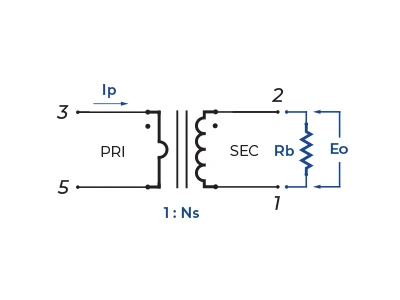
    Terminating Resistor (RB): To calculate the value use the formula,
    RB = EOTR/IP

  • 8.

    ET Product: The maximum ET is based upon a flux density of 1175 Gauss at 25°C. Suitable for bipolar applications only.

    ET = EO/2f
    EO = IPRB/TR

    Whereas,
    EO = Output voltage (V)   TR = Turns Ratio
    RB = Term. Resistor (Ω)       f = Frequency (Hz)
    IP = Primary Current (A)

  • 9.

    PACKAGING

    • Pieces/Tray: 121

    • Trays/Box: 10

    • Pieces/Box: 1210

Specifications subject to change without prior notice.

Frequently Asked Questions (FAQs)

How do I choose the right turns ratio for CT05 in my design?

+
You should select a turns ratio based on the sense-voltage requirements of your controller or monitoring circuit, and the expected primary current. Lower ratios (1:50) suit higher-current rails with modest sense-voltage needs, while higher ratios (1:500 or 1:1000) generate larger sense voltages — useful for lower-current rails or where high resolution is needed. Always confirm that burden resistor selection and switching frequency keep flux-time (ET) within the transformer's rated limits.

What burden resistor should I pair with CT05 to get accurate current sensing?

+
Use a burden resistor that produces enough sense voltage for your measurement or controller input while keeping the transformer in safe operating limits. The datasheet provides an ET-product formula and maximum ET threshold; selecting R_B using ET = (Ip × Rb / TR) / (2·f) helps ensure accurate waveform reproduction without saturating the core.

Is CT05 suitable for current-mode SMPS controllers or over-current protection circuits?

+
Yes. CT05 supports current-mode control loops, over-current detection, load-drop monitoring, and general current-sense tasks in AC/DC and DC/DC converters. Its combination of high current capacity, isolation, and flexible turns ratios makes it a good candidate for these applications.

Does CT05 require specific PCB layout or wiring practices for optimal performance?

+
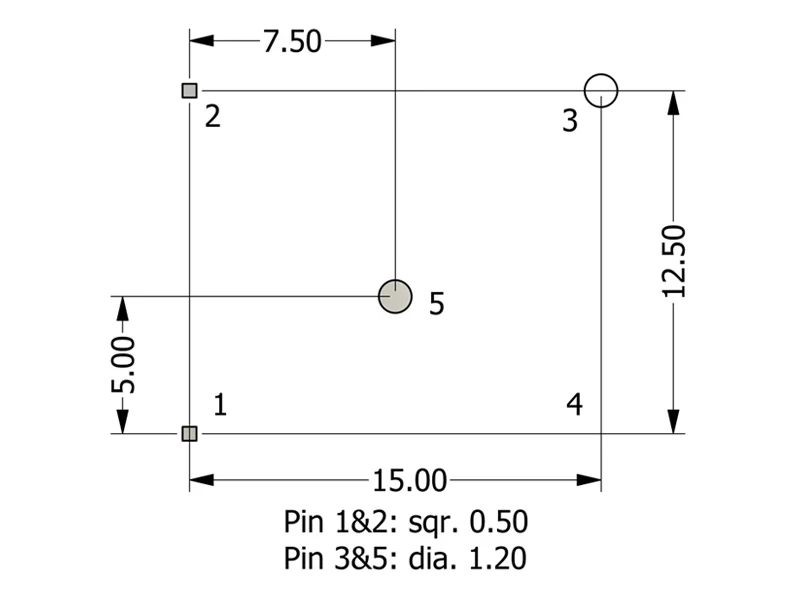
Because CT05 is a through-hole transformer with a bar-primary design, ensure the primary conductor or PCB trace is rated for the intended current, and secondary traces plus the burden resistor are kept short and routed away from high-noise switching nodes. Good layout reduces parasitic noise and improves measurement accuracy.

Can CT05 accurately sense pulsed or non-sinusoidal currents typical of switching power supplies?

+
Yes. CT05 is designed for switch-mode converter current sensing and can handle pulsed or non-sinusoidal waveforms, provided the duty cycle, ET-product, and burden resistor are appropriately designed according to the datasheet guidelines.

What isolation and safety rating does CT05 provide?

+
CT05 is Hi-Pot tested to 4000 VAC primary-to-secondary isolation. This makes it suitable for applications requiring safe isolation between the high-current primary path and low-voltage sensing or control circuits, such as AC mains front-ends or isolated DC/DC converters.

What are the thermal and environmental limits for CT05 operation?

+
The CT05 Series operates from –40 °C to +130 °C ambient (or ambient + temperature rise depending on load). This ensures reliability in industrial, telecom, and other demanding environments under varying thermal conditions.

How is CT05 typically arranged in a current-sense measurement path on a PCB?

+
The current to be monitored is passed through the transformer’s primary path (bar-style or PCB trace), while the secondary winding, together with the burden resistor, delivers a scaled, isolated voltage proportional to that current. This configuration supports accurate sensing of power-rail currents, inductor currents, or supply lines without inserting a shunt resistor in the primary path.

What factors impact CT05’s performance at higher switching frequencies near 500 kHz?

+
At high switching frequencies, factors such as secondary inductance, burden resistor value, PCB parasitics, and the transformer’s SRF (self-resonant frequency) affect accuracy. Designers should ensure the burden and layout design maintain good waveform fidelity and stay within the ET-product and the component’s frequency rating.

Where can I find datasheets, 3D models, or simulation files for CT05?

+
All relevant documentation — including datasheet, mechanical drawings, recommended PCB footprint, and requests for SPICE or 3D CAD models — are available via the CT05 product page on ICE Components’ website. This ensures easy integration into design, simulation, and layout workflows.