- Home
- Inductors
- High-Current Ferrite-Bead Power Inductors
- LP02-3 SERIES: SMT High-Current Ferrite-Bead Inductors
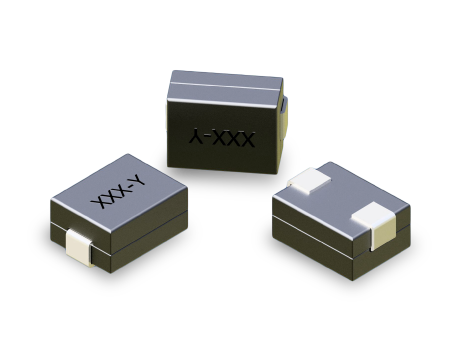
Key Features
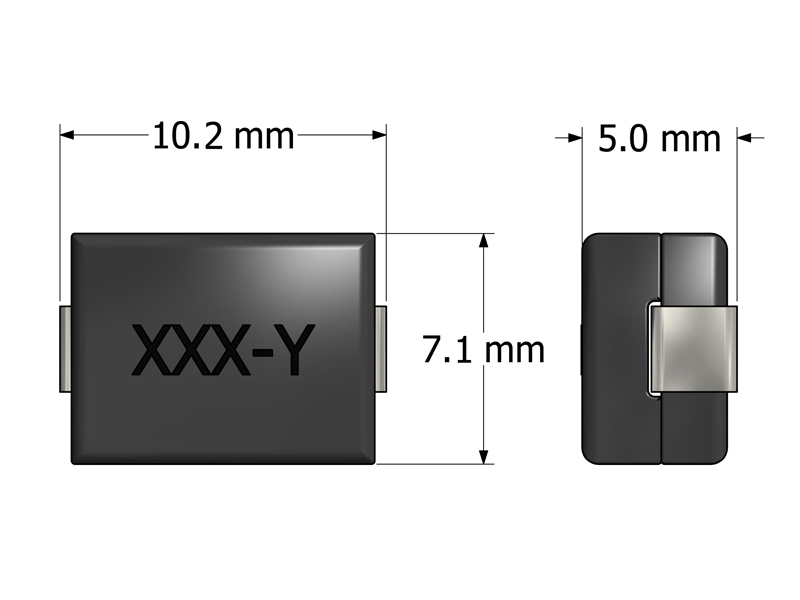
- Compact footprint 10.2 × 7.1 mm and height 5.0 mm for dense layout
- Inductance range 90–350 nH for low-impedance, high-current filtering
- Saturation capability up to 72 A for demanding VRM and converter loads
- Low-DCR winding for high efficiency and minimal thermal loss
- Supports up to 1 MHz switching frequency for high-speed converters
- SMT package supports automated pick-and-place assembly
- Design verified by leading IC manufacturers
APPLICATIONS
- Voltage Regulator Modules (VRMs) for CPUs, GPUs, SoCs
- Point-of-Load (POL) converters in servers, notebooks, and compact devices
- High-frequency synchronous buck or boost DC/DC converters
- Compact power modules on space-constrained PCBs
- High-current power rails in telecom, industrial, and embedded power systems
- Voltage Regulator Modules (VRMs) for CPUs, GPUs, SoCs
- Point-of-Load (POL) converters in servers, notebooks, and compact devices
- High-frequency synchronous buck or boost DC/DC converters
- Compact power modules on space-constrained PCBs
- High-current power rails in telecom, industrial, and embedded power systems
Electrical Specifications @ 25°C - Operating Temperature Range1: -40°C to +130°C
Part Number
Inductance2
(nH, ±15%)
DCR3
(mΩ, ±10%)
ISAT4 (A)
IDC5 (A)
Part Number
Inductance2 (nH, ±15%)
DCR3
(mΩ, ±10%)
ISAT4 (A)
IDC5 (A)
Mechanical Drawing
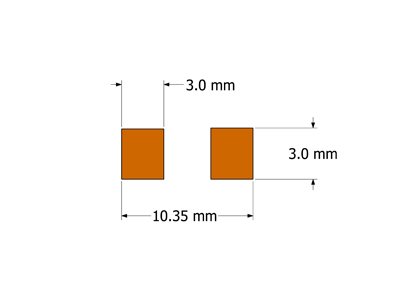
Recommended PCB Layout
Schematic

-
Operating Temp. Range: The combination of ambient temperature and temperature rise.
-
Inductance: Tested at 1MHz, 0.1 VRMS.
-
Tighter DCR tolerances available. Contact ICE for more details.
-
ISAT: DC current through the winding to cause a 15% (typ) drop in inductance.
-
IDC: DC current through the winding to cause a 40°C (typ) temperature rise at 25°C ambient. PCB layout, trace thickness and width, airflow and proximity to other devices will affect the temperature rise.
-
PACKAGING
- Reel Diameter: 13″
- Reel Width: 16mm
- Pieces Per Reel: 800
-
Specifications subject to change without prior notice.
Frequently Asked Questions (FAQs)
How does the LP02-3 inductor’s construction influence core saturation under load?
LP02-3 uses a low-profile magnetic core and optimized winding that delay the onset of saturation compared to similar low-inductance SMT parts. As current rises toward the saturation point, inductance begins to fall gradually rather than abruptly, which helps maintain predictable behavior in high-current converter stages.
What layout factors most affect LP02-3 thermal performance on a PCB?
Because LP02-3 is designed for high-current operation, its actual temperature rise depends heavily on copper thickness and area connected to its terminals, the number and placement of thermal vias, and airflow over the board. Maximizing copper around the inductor and using proper heat dissipation strategies significantly lowers operating temperature.
What is the impact of DC bias on LP02-3 inductance stability?
Under significant DC bias, inductance in LP02-3 will decrease as core flux approaches saturation. This DC-bias characteristic is expected and can be modeled as part of converter design to ensure it still meets ripple requirements at operating current.
What trade-offs exist between DCR and efficiency in the LP02-3 design?
Lower DCR reduces conduction loss, but achieving low DCR and low inductance in a compact SMT package inherently requires larger cross-section wire and a careful balance of turns and core material. Designers should verify that low DCR does not excessively compromise the required inductance for ripple filtering in their specific converter topology.
How does LP02-3 perform under reverse transient events?
In bidirectional or reverse-current conditions, LP02-3’s magnetic core and winding can experience rapid flux changes. While it can handle transient reversal within its ratings, system designers should ensure that switching algorithms and protection loops account for the fast di/dt and avoid operating continuously in reverse beyond rated currents.
Why is trace symmetry important when using LP02-3 in multiphase converters?
In multiphase buck converters, unequal trace length or copper balancing between phases can lead to uneven current distribution, causing one inductor to carry more current than others. Maintaining symmetrical layouts ensures balanced loading across LP02-3 inductors and minimizes thermal and electrical stress.
What should be considered when simulating LP02-3 in a power converter model?
For accurate simulation, include real DCR, core loss, and DC-bias inductance roll-off rather than an ideal inductor model. This enables more realistic predictions of efficiency, ripple current, and thermal behavior under load.
Can LP02-3 inductors handle repetitive surge currents?
LP02-3 can endure short surge events within its saturation and thermal limits, but repeated surges at or above rated current can increase temperature and accelerate core or winding degradation. Designers should size the inductor with adequate current margin for surge conditions.
What impact does proximity to other components have on LP02-3 performance?
Because of magnetic and electric field interactions at high di/dt, nearby switching nodes or high-current paths can induce noise. Maintaining reasonable clearance from sensitive nodes and careful grounding helps maintain signal integrity and reduces unintended coupling.
How does LP02-3’s inductance change with temperature?
Like most power inductors, LP02-3 exhibits some inductance variation over temperature due to core permeability changes. Good thermal management not only reduces temperature rise but also stabilizes inductance behavior over operating conditions.