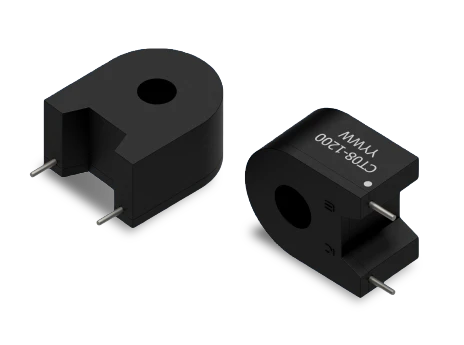
CT08 SERIES: Tombstone THT Current Sense Transformers
50 A Max | 1:1200 | 40 Hz – 4.7 kHz | 3,750 VAC
The CT08 Series is a high-current, through-hole current sense transformer designed for isolated measurement of low-frequency AC or pulsed DC currents. With a primary current rating of 50 A, the CT08 enables accurate sensing of large-gauge wires or PCB conductors routed directly through its core. Its through-hole construction and compact footprint support secure PCB mounting in industrial and power-management applications.
Engineered for applications where currents vary slowly or operate at low AC frequencies, the CT08 Series supports an effective sensing range from 40 Hz to approximately 4.7 kHz. A fixed 1:1200 turns ratio, 3750 VAC isolation rating, and –40 °C to +105 °C operating range make CT08 well-suited for motor-drive systems, UPS and inverter monitoring, battery-control circuits, and low-frequency industrial power measurement requiring galvanic isolation.
Key Features
- Tombstone through-hole (THT) current-sense transformer
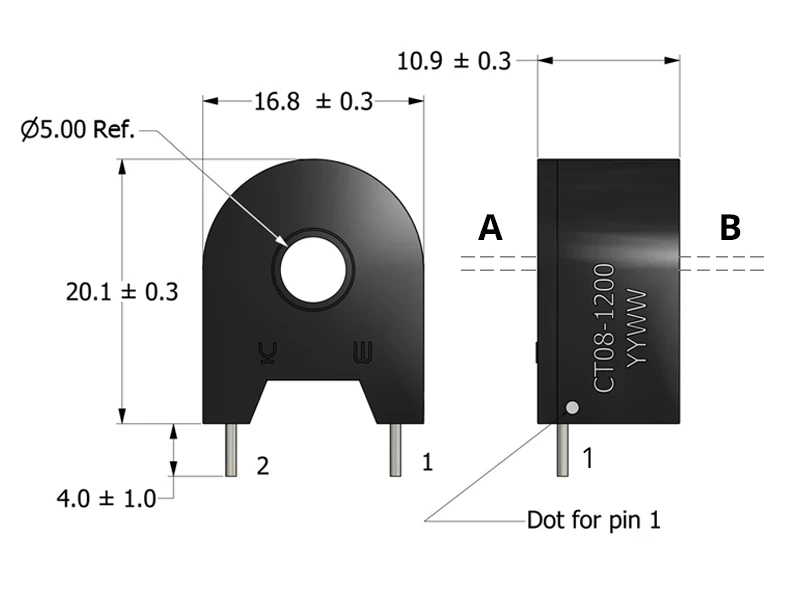
- Compact 17.1 mm × 11.2 mm PCB footprint, 20.4 mm height
- Supports primary currents up to 50 A
- Supports SMPS switching frequencies from 40 Hz to 4.7 kHz
- Fixed turns ratio: 1:1200 (single-turn primary)
- 3750 VAC primary-to-secondary isolation (Hi-Pot tested)
- Nanocrystalline Cores Ensure High Accuracy / Lower Core Loss
APPLICATIONS
- Low-frequency AC current monitoring
- Motor-drive and motor-phase current measurement
- UPS and inverter output current sensing
- Battery systems and energy-storage current measurement
- Industrial equipment requiring isolated current feedback
- Pulsed DC sensing in control and protection circuits
Electrical Specifications @ 25°C - Operating Temperature Range1: -40°C to +105°C
CT08-1200
1:1200
10
40
50
4.7
3000
3750
-
1.
Operating Temp. Range: The combination of ambient temperature and temperature rise.
-
2.
Current Rating: The primary current rating is for reference only and is limited by the current capacity of the customer-supplied primary conductor.
-
3.
Self-Resonant Frequency: The value is for reference only.
-
4.
Flammability Standard: Meets UL 94V-0.
-
5.
Material Rating: Meets requirements for UL Class A temperature rating. Ambient + Temp. Rise + Hotspot Allowance < 105 ºC
-
6.
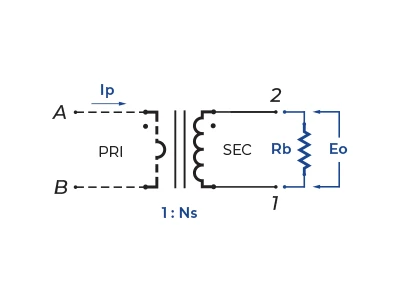
Terminating Resistor (RB): To calculate the value use the formula,
RB = EOTR/IP
-
7.
ET Product: Rated at 100ºC. Suitable for bipolar applications only.
ET = EO/2f
EO = IPRB/TR
Whereas,
EO = Output voltage (V) TR = Turns Ratio
RB = Term. Resistor (Ω) f = Frequency (Hz)
IP = Primary Current (A)
-
8.
Packaging:
- Pieces/Tray: 66
- Trays/Box: 10
- Pieces/Box: 660
-
9.
Compliance & Solutions:



-
10.
Specifications subject to change without prior notice.
Frequently Asked Questions (FAQs)
CT08 is rated up to 50 A RMS (primary current) under reference conditions. The actual current limit depends on the conductor used as the primary — CT08 itself will not limit the conductor’s ampacity.
CT08 supports frequencies from ~30 Hz up to ~4.7 kHz in standard configurations, making it suitable for mains AC, low-frequency switching supplies, motor control, inverters, or pulse-based loads — but not ideal for high-frequency SMPS or high-rate gate-drive measurement.
CT08 uses a 1:1200 turns ratio: the secondary winding’s output is scaled down relative to the primary current by a factor of 1200. Designers must apply an appropriate burden resistor at the secondary to convert the scaled current into a measurable voltage, staying within the transformer’s volt-microsecond (V·µs) limits to avoid core saturation.
No — as a conventional current-sense transformer, CT08 requires an alternating or pulsed current (AC or varying DC). It cannot reliably sense steady DC current because there would be no change in magnetic flux to induce secondary current.
CT08 is a through-hole transformer with a 3750 VAC primary-to-secondary isolation (Hi-Pot) rating and meets flammability/temperature standards appropriate for industrial power applications.
Because CT08’s self-resonant frequency (SRF) is relatively modest, and its bandwidth is limited to a few kHz, it may not accurately track very high-frequency or high-dv/dt signals. In addition, the primary conductor must be specified carefully — including current rating, thermal capacity, and mechanical integrity — since CT08 does not provide protection for the conductor itself.
Calculate the burden resistor based on the expected primary current, the 1:1200 turns ratio, and desired output voltage — ensuring the resulting volt-microsecond product stays within the rated limit. Over-sizing the burden resistor or exceeding rated current/frequency can cause core saturation and measurement distortion.
Yes — CT08 offers several advantages over shunts: minimal insertion loss (no series resistance), galvanic isolation between primary and measurement circuits, and lower heating under heavy current. However, unlike shunts, CT08 cannot measure steady DC and requires a suitable burden resistor and secondary circuit design.
CT08 is ideal for high-current, low- to mid-frequency systems such as motor controllers, industrial AC load monitoring, inverters, UPS and battery systems, AC mains metering, and switching supplies where current pulses or AC are expected.
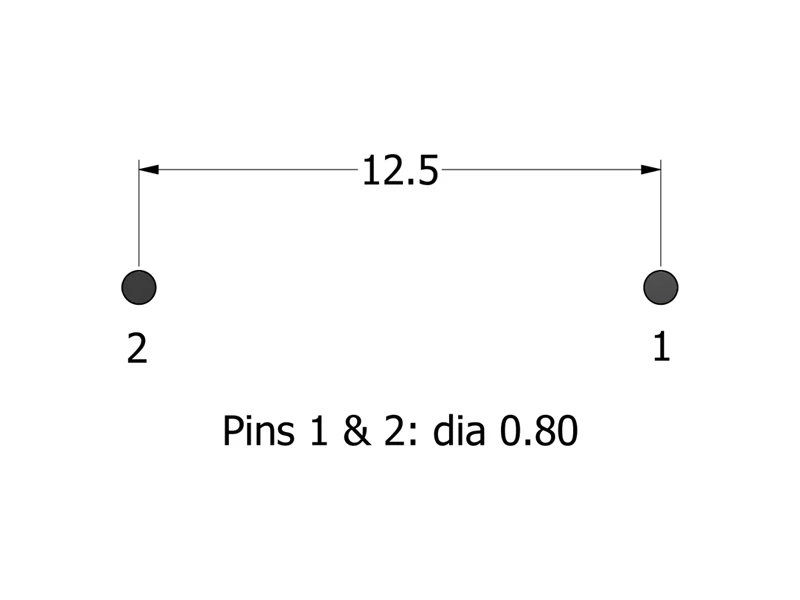
Because CT08 is a through-hole transformer, ensure the PCB layout supports its pin spacing and footprint. The primary conductor must be routed centrally through the core opening, with adequate copper width to carry the rated current without excessive heating. Also design for clearance and creepage distances if galvanic isolation and safety standards apply.
Here is the Spice data file for CT08 SERIES: Tombstone THT Current Sense Transformers
Download
Here is the 3D file for CT08 SERIES: Tombstone THT Current Sense Transformers
Download