- Home
- Power Designs
- Power Supplies
- 90W Power Supply
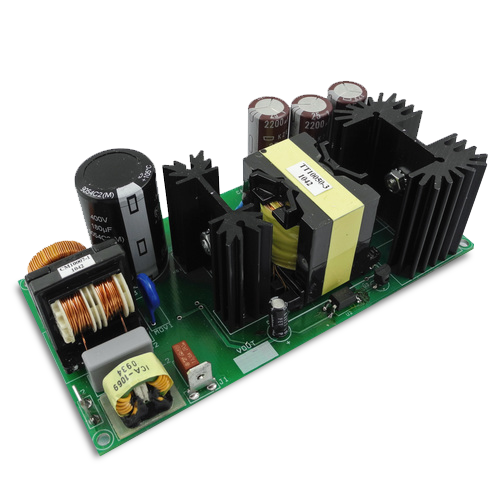
Key Features
- Operating Temperature: -20°C to +50°C
- Storage Temperature: -40°C to +85°C
- Isolation Voltage: 3750 VAC for 1 Minute
- AC Operation: 90 VAC to 264 VAC @ 47 Hz to 63 Hz
- AC Under/Over Voltage: 80 VAC /280 VAC
- Output Adjustment: +/-20%
- Short Circuit Protect (Hiccup Mode)
- Overload Protection at 150% of Max
- Over Voltage Protection at 130% of Output
- Under Voltage Lockout
- Hold up Time: 10 ms / 20 ms at 115 V / 230 V
- Humidity: Operating; Noncondensing 10% to 90% RH
- Vibration: IEC68-2-6
- Emissions: Class B Conducted (FCC, CISPR22 & EN55022)
- Leakage: <300 mA @50 Hz / 60 Hz and 264 VAC input
- Safety Standards: 60601-1 and 60950
- Over Voltage Protection at 130% of Output
- Under Voltage Lockout
- Hold up Time: 10 ms / 20 ms at 115 V / 230 V
- Humidity: Operating; Noncondensing 10% to 90% RH
- Vibration: IEC68-2-6
- Emissions: Class B Conducted (FCC, CISPR22 & EN55022)
- Leakage: <300 mA @50 Hz / 60 Hz and 264 VAC input
- Safety Standards: 60601-1 and 60950
-
Free custom design to fit your needs
-
Includes safety and EMI support
-
Project must meet requirements for quantity and complexity
-
Option to build yourself, at a CM or ICE
-
Design held in escrow to assure continuity
-
Specifications subject to change without prior notice.
Frequently Asked Questions (FAQs)
What does the “90W” rating actually mean in practice?
The 90W designation refers to the maximum output power the supply can deliver continuously without exceeding its thermal limits under specified ambient conditions. Operating continuously at or near 90W requires adequate cooling and PCB design to manage heat dissipation without forcing thermal shutdown or derating.
Why are there two standard output options (15V and 24V)?
Offering both 15V and 24V variants lets designers match the power supply to common industrial and telecom rail levels without external converters. The 15V is typical for control and logic loads, while 24V suits more traditional industrial automation power distribution.
How does output ripple affect downstream circuits and what should designers consider?
Output ripple (e.g., ≈50 mV p-p for 15V and 100 mV p-p for 24V) represents high-frequency remnants of switching operation. Too much ripple can affect sensitive analog or digital circuits. Designers may need additional filtering (e.g., low-ESR caps or LC filters) at the load to meet tight ripple requirements in noise-sensitive applications.
What are the thermal constraints designers need to observe?
Although the supply can deliver its rated output, internal losses (switching loss, core loss, conduction loss) generate heat. Adequate convective cooling, proper board layout with copper pour for heat spreading, and not placing the supply in thermally stagnant enclosures help ensure stable thermal performance and long life.
What level of load transient response can be expected?
The supply is designed for general-purpose loads; it will respond to typical load changes without significant overshoot. However, extreme, rapid load steps (e.g., from very light to full load in microseconds) may stress regulation. Designers should verify transient requirements if their load profile includes dramatic, fast power swings.
How does the built-in protection behave when a fault occurs?
The 90W modular supply includes overload, short-circuit, and over-voltage protections. Upon detecting a fault condition, it typically enters a hiccup or shutdown mode and attempts automatic recovery. Designers should design upstream logic to manage recovery and avoid cascading resets in critical systems.
What input voltage range and conditions should the 90W supply expect?
The supply is intended for standard AC mains inputs (e.g., full universal AC range). It must be operated within its specified AC input range and not on degraded or over-voltage sources without additional line conditioning, or it may derate or trigger input protection.
What efficiency behavior should be expected across load range?
Efficiency varies with output voltage and load — generally higher at mid-to-high load (e.g., 60–89% of rated load) and slightly lower at very light loads due to fixed switching overhead. Verifying efficiency curves is important when optimizing thermal design and power budgets for battery-powered or thermally constrained systems.
Are there any considerations for grounding and reference when integrating the supply?
Yes — proper system grounding helps reduce noise and ensures safety. Engineers should interface the supply’s return with system ground in a controlled way, considering signal integrity and chassis bonding, especially if downstream converters or controls require a stable reference.
How can designers verify compliance with system-level EMC or safety requirements using this supply?
Although the supply includes basic protections, compliance with broader EMC and safety standards (e.g., CISPR, IEC/EN limits) depends on the final assembly and enclosures. Designers should perform their own system-level testing or include supplementary filtering, shielding, or safety barriers as required by their end application regulatory requirements.